Skip to content

Murder Book: 09. Digital and Documentary Evidence

  • Johnnie Robinson – The Birmingham News Article, “Council Asks All Facts on Two Deaths”

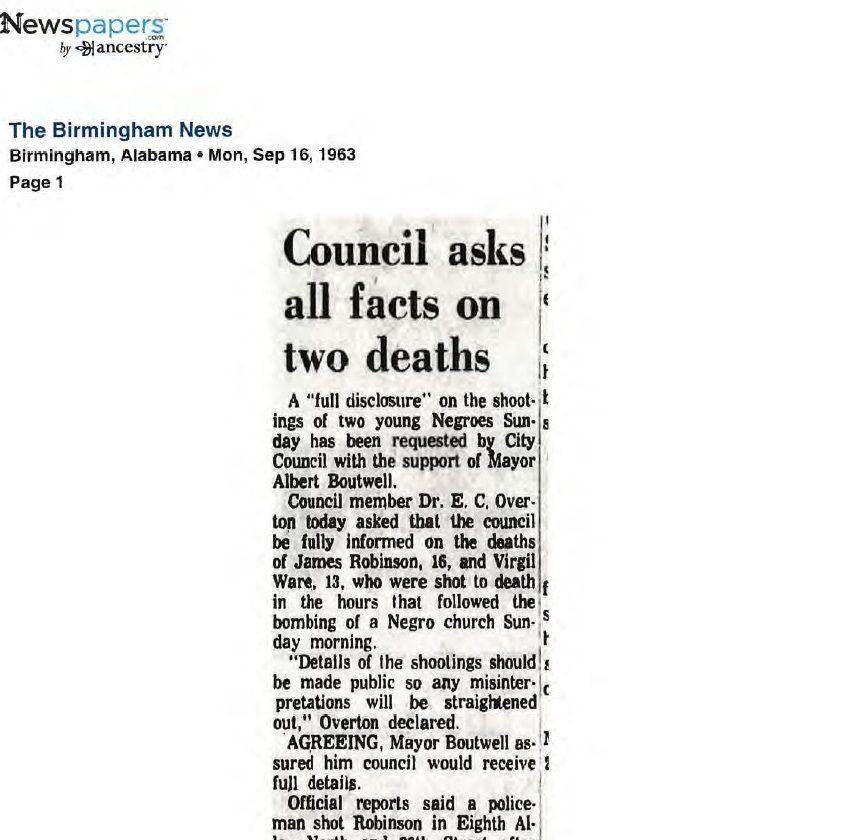
    Johnnie Robinson – The Birmingham News Article, “Council Asks All Facts on Two Deaths”

    September 16, 1963 article from The Birmingham News reporting that the Birmingham City Council, with the support of Mayor Albert Boutwell, requested a “full disclosure” of the circumstances surrounding the fatal shootings of Johnnie Robinson and Virgil Ware following the bombing of Sixteenth Street Baptist Church. Council member Dr. E. C. Overton called for the details to be made public to prevent misunderstanding, and Boutwell stated that the council would receive a full account.

    The article summarizes early official accounts of Robinson’s shooting near Eighth Alley North and 26th Street, including reports that he was struck in the back and that the police investigation remained ongoing. The article incorrectly identifies Robinson as “James Robinson” in one passage, although other records establish his name as Johnnie Brown Robinson. It also reports University Hospital as the place where he was pronounced dead, a detail that differs from other surviving official records and should be preserved as a contemporary reporting discrepancy rather than silently corrected.
  • Johnnie Robinson – The Birmingham Post-Herald Article, “Racial Cost: Children Pay Price So Far”

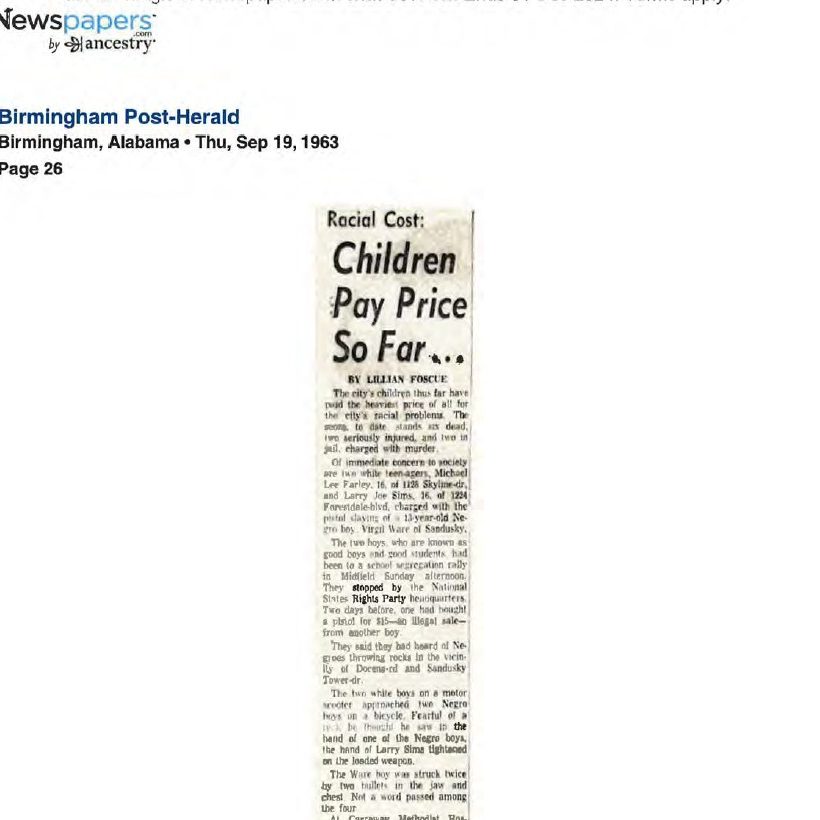
    Johnnie Robinson – The Birmingham Post-Herald Article, “Racial Cost: Children Pay Price So Far”

    September 19, 1963 article from the Birmingham Post-Herald examining the impact of Birmingham’s racial violence on children and adolescents. The article discusses several young people injured, killed, or charged with crimes amid racial unrest, including victims of the September 15 bombing of Sixteenth Street Baptist Church and other incidents occurring during the same period.

    The article identifies Johnnie Robinson as another victim of the city’s racial conflict and reports that he was fatally shot by police after running when ordered to stop. The article incorrectly gives Robinson’s age as 18; other primary records establish that he was 16 years old. The discrepancy should be retained as part of the historical newspaper record rather than silently corrected in the transcription or description.

  • Johnnie Robinson – The Birmingham Post-Herald Article, “Shooting Still Being Probed”

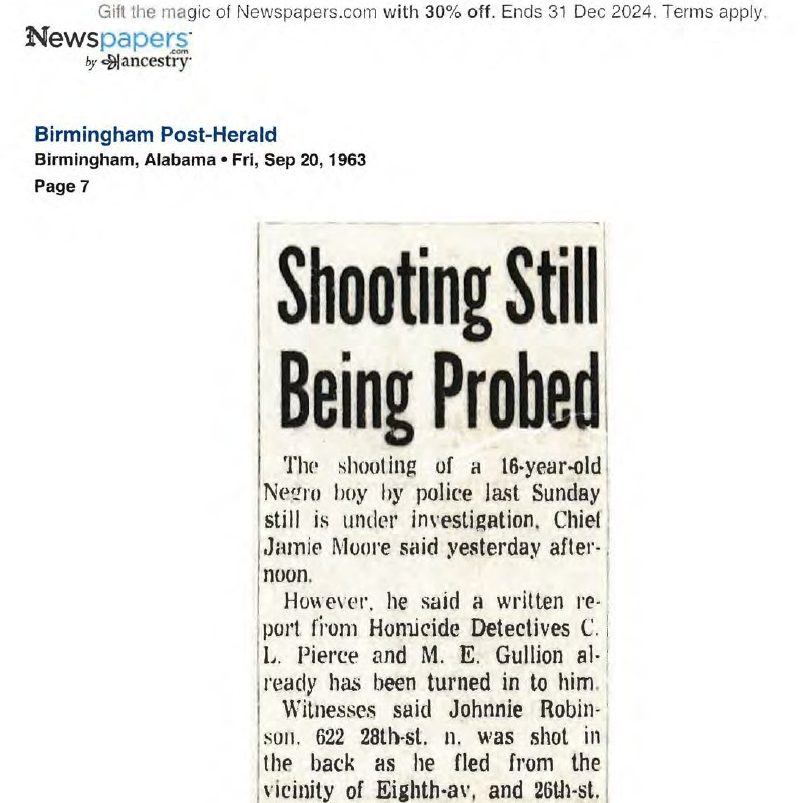
    Johnnie Robinson – The Birmingham Post-Herald Article, “Shooting Still Being Probed”

    September 20, 1963 article from the Birmingham Post-Herald reporting that the fatal police shooting of 16-year-old Johnnie Robinson remained under investigation five days after his death. The article states that Birmingham Police Chief Jamie Moore had received a written report from Homicide Detectives C. L. Pierce and M. E. Gullion and recounts witness and police accounts that Robinson was shot in the back while fleeing from the vicinity of Eighth Avenue and 26th Street North.

    The article further reports that Robinson was pronounced dead on arrival at a hospital from gunshot wounds. Because this is a contemporary press account rather than an official investigative record, statements concerning the circumstances of the shooting and hospital identification should be understood as information reported by the newspaper rather than independently established findings of the repository.

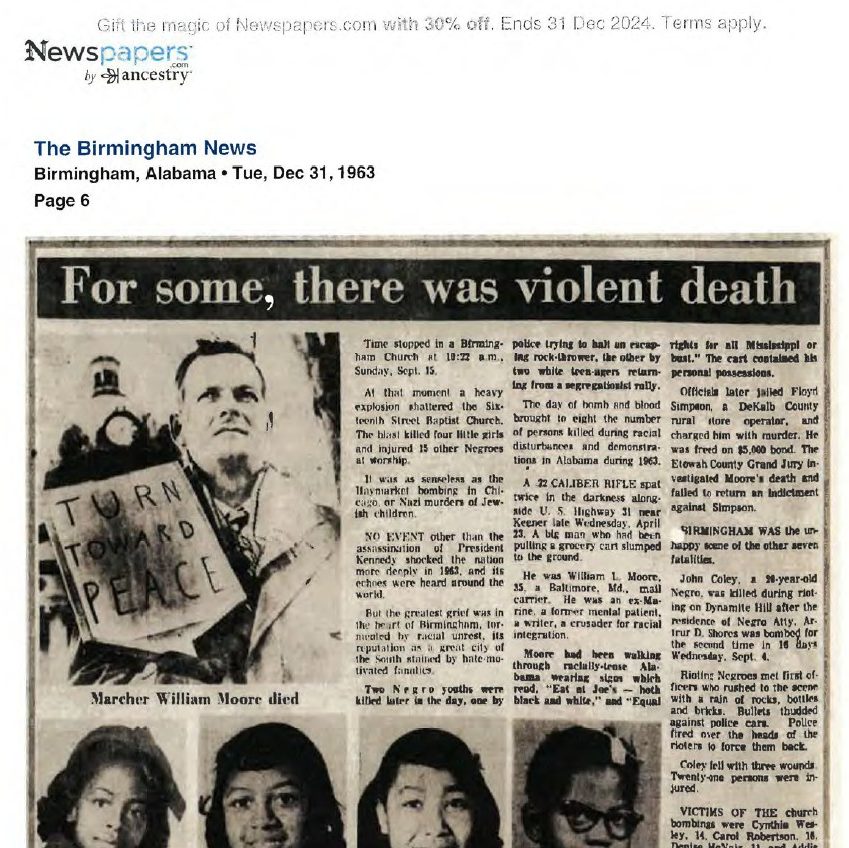
  • Johnnie Robinson – The Birmingham News Article, “For Some, There Was Violent Death”

    Johnnie Robinson – The Birmingham News Article, “For Some, There Was Violent Death”

    December 31, 1963 article from The Birmingham News reviewing several violent deaths associated with racial conflict and civil-rights unrest in Alabama during 1963. The article discusses the bombing of Sixteenth Street Baptist Church and the deaths of Addie Mae Collins, Denise McNair, Carole Robertson, and Cynthia Wesley, as well as the killings of William Moore, John Coley, Virgil Ware, and Johnnie Robinson.

    The article identifies Robinson as a 16-year-old who was killed by police later on September 15, 1963, the same day as the church bombing, and places his death within the wider context of racial violence in Birmingham that year. The clipping therefore provides contemporaneous retrospective context rather than a detailed investigative account of Robinson’s shooting.

  • Johnnie Robinson – Photographs of the Birmingham Demonstrations by Bob Adelman, May 1963

    Johnnie Robinson – Photographs of the Birmingham Demonstrations by Bob Adelman, May 1963

    Six-page compilation of photographs by documentary photographer Bob Adelman depicting civil-rights demonstrations in Birmingham, Alabama, in May 1963. The images show demonstrators, bystanders, police officers, police motorcycles, and scenes of confrontation and crowd control during the Birmingham campaign. The compilation identifies the photographs as “Birmingham Demonstrations” and dates them to May 1963.

    Archival note: The photographs predate Johnnie Robinson’s September 15, 1963 death by approximately four months and do not document Robinson, Officer Jack Parker, or the circumstances of Robinson’s shooting. Their value within the case file is therefore historical and contextual, illustrating the civil-rights demonstrations, police presence, and racial environment in Birmingham during the same year as Robinson’s death.

  • Johnnie Robinson – Federal Bureau of Investigation Civil Rights Investigation File: Officer Jack Parker

    Johnnie Robinson – Federal Bureau of Investigation Civil Rights Investigation File: Officer Jack Parker

    Sixty-four-page Federal Bureau of Investigation civil-rights investigative file concerning Birmingham Police Department Officer Jack Parker and the fatal shooting of Johnnie Brown Robinson. The records are associated with FBI Birmingham Field Office File No. 44-1087 and Bureau File No. 44-23325 and document federal investigative activity beginning after Robinson’s September 15, 1963 death. The file contains FBI reports, airtels and internal communications, witness interviews, biographical and investigative information concerning Robinson and Parker, newspaper clippings, coordination with the U.S. Attorney and local authorities, and records concerning state and federal grand-jury proceedings.

    The file records that a Birmingham grand jury returned a no-bill as to Parker in October 1963 and that the matter was subsequently presented to a federal grand jury in August 1964. The federal grand jury likewise returned a no-bill on August 28, 1964. The compilation therefore documents both the FBI’s investigation of Robinson’s death and the eventual federal prosecutorial disposition of the case.

  • Johnnie Robinson – Birmingham Police Department Surveillance File 1125.8.40: Johnnie Robinson Shooting Investigation

    Twenty-six-page archival compilation from Birmingham Police Department Surveillance File 1125.8.40 concerning the September 15, 1963 fatal shooting of Johnnie Robinson by Birmingham Police Officer Jack Parker. The file includes Detective C. L. Pierce’s initial investigative report, which describes the police pursuit, Parker’s discharge of a shotgun, Robinson’s injuries and death, and the subsequent collection of witness and officer statements.

    The compilation also contains a Jefferson County coroner record, correspondence documenting federal interest in the investigation, statements from civilian witnesses, and statements from Birmingham police officers, including Parker’s account of firing a 12-gauge shotgun toward the ground as Robinson and another youth ran through the alley.

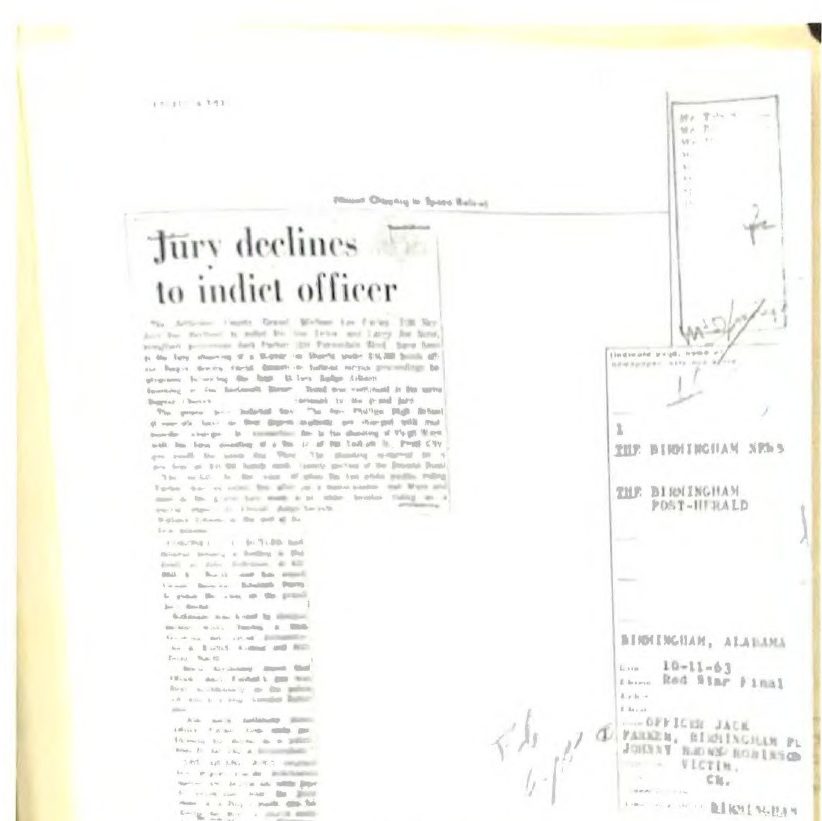
  • Johnnie Robinson – Newspaper Article, “Jury Declines to Indict Officer”

    Johnnie Robinson – Newspaper Article, “Jury Declines to Indict Officer”

    Contemporary newspaper clipping headlined “Jury Declines to Indict Officer,” reporting that a grand jury declined to indict Birmingham Police Officer Jack Parker in connection with the fatal shooting of Johnnie Robinson. The surviving reproduction is mounted on a clipping-service sheet identifying Birmingham, Alabama, and bearing the date October 11, 1963; the sheet references The Birmingham News and The Birmingham Post-Herald, although the surviving reproduction does not permit the specific publication of the clipping to be established with confidence. The article documents contemporary public reporting of the grand-jury disposition and was preserved as part of the Robinson investigative record.

  • Sammie Lee Williams – The Birmingham News Obituary, “M.A. Weeks”

    Sammie Lee Williams – The Birmingham News Obituary, “M.A. Weeks”

    Newspaper obituary for Mody Andrews Weeks, age 68, documenting his death at a local hospital and summarizing his personal and occupational history. The notice identifies Weeks as a native of Lamar County and longtime Birmingham resident, notes his 41-year career with the Birmingham Transit Company, and records his World War I service, membership in the Veterans of Foreign Wars, church affiliation, funeral arrangements, burial at Crews Cemetery, and surviving family members. The clipping bears a February 22, 1964 date stamp, but the newspaper of publication is not identified on the surviving copy.

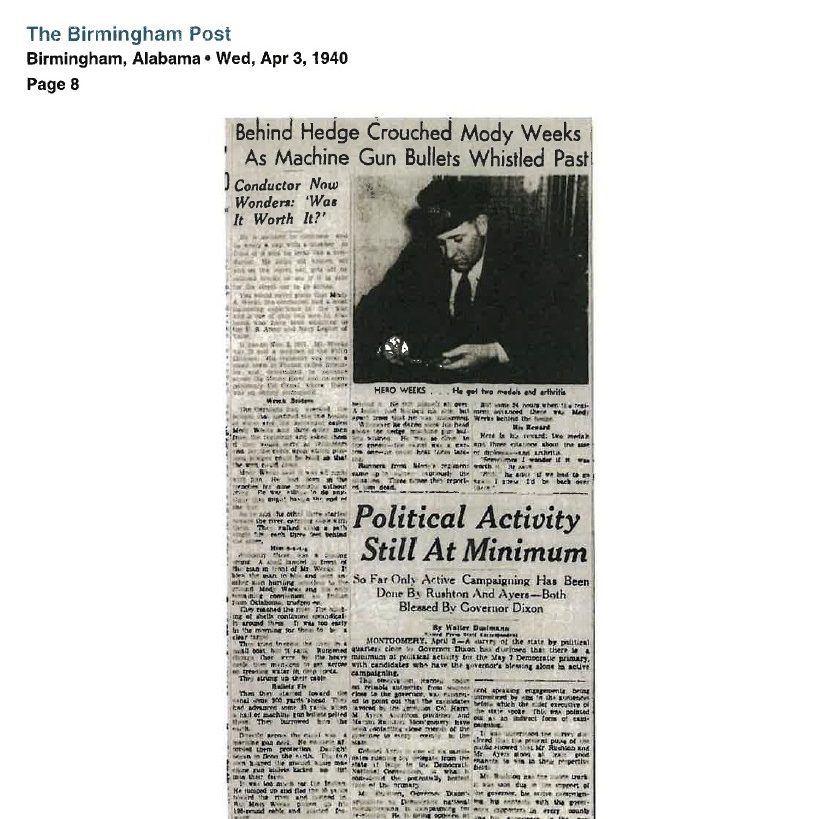
  • Sammie Lee Williams – The Birmingham Post Article, “Behind Hedge Crouched Mody Weeks as Machine Gun Bullets Whistled Past”

    Sammie Lee Williams – The Birmingham Post Article, “Behind Hedge Crouched Mody Weeks as Machine Gun Bullets Whistled Past”

    April 3, 1940 feature article from The Birmingham Post profiling Mody A. Weeks, then identified as a streetcar conductor, and revisiting his World War I combat service. The article recounts Weeks’s experience under machine-gun fire and reflects on his wartime service through the question, “Was It Worth It?” The clipping includes a contemporary photograph of Weeks.